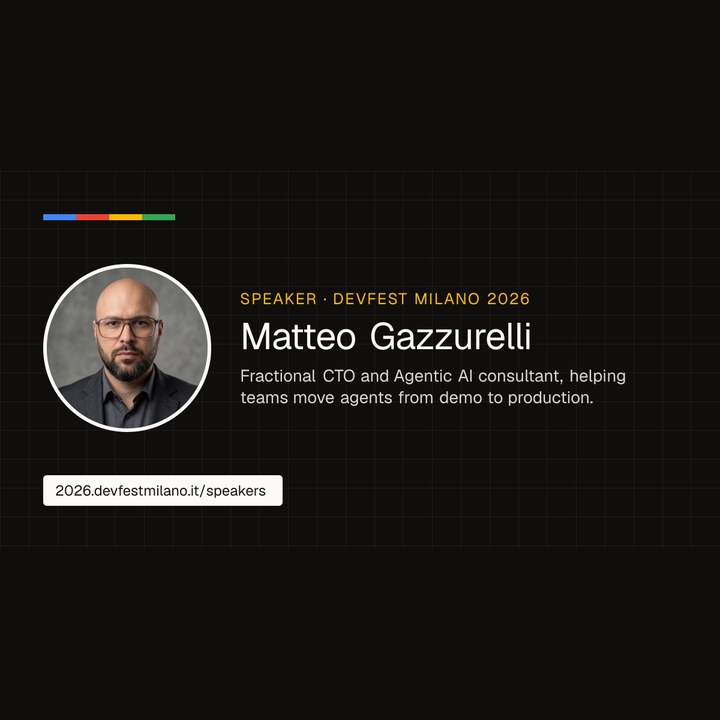
Production-ready AI agents on Google and Claude.
I put AI agents into production for teams with real, repeatable processes — and I'm the senior technical call for founders who need it without a full-time hire. I'll tell you honestly if AI doesn't make sense for your case — no sales pitch.
Matteo Gazzurelli · Fractional CTO & Agentic AI Consultant · Brescia, Italy
The Problem I Solve
Most companies experimenting with AI agents get stuck somewhere between the demo and the deploy.
The proof-of-concept works in a notebook, but breaks the moment it meets real users, real latency, real edge cases. The team picks a framework based on a Twitter thread. Six months in, you have three half-working agents and no clear path to production.
I've spent the last couple of years helping teams move past that wall — choosing the right platform for their case, designing systems that handle failure gracefully, and getting agents into production where they actually do useful work.
The Stack I Work With
I focus deliberately on two platforms. Knowing two of them deeply — their real tradeoffs, where they crack and where they shine — tends to be worth more in production than knowing eight frameworks shallowly.
Claude — Agent SDK and Code
Anthropic's Agent SDK for building production agents on Claude, plus Claude Code for the development workflow. A strong choice when the model itself is the differentiator — long context, instruction-following, agentic coding.
My take:these are equivalent choices with real tradeoffs — there's no universal winner. Google is my default for enterprise clients on GCP; Claude tends to win when the team needs the model's specific strengths or runs outside Google's ecosystem. Both are valid. The right call depends on the case, and I'll tell you which.
A partner for production AI implementation
Over 20 Years in Software
250+ Projects Shipped
Google Partner
GDG Brescia Organizer
I've been building software for over 20 years — 250+ projects shipped across mobile, cloud and distributed systems. For the last couple of years I've focused on a single question: how do you build AI agents that hold up in production, not just in slides. I run agentic automation for teams in Northern Italy & Switzerland, and fractional-CTO work with international teams, remote.


- Google Partner(through MaGa Srl) — Google Cloud Select Co-sell Partner and Google Workspace Select Co-sell & Services Partner. Verify on the Google Cloud Partner Directory →
- GDG Brescia Organizer — I run the Google Developer Group in Brescia, building the local agentic AI community.
- Google Cloud & AI certifications — multiple, kept current.
- Over 20 years in software, 250+ projects shipped across mobile, cloud and distributed systems.
Tech Stack
How I Work
Three engagement models. No long contracts, and a clear stop point at every stage.
I help you pick the right platform for each use case — Google or Claude
Built WITH teams, not TO them
Knowledge transfer, so you don't depend on me
No long contracts, no lock-in
Discovery & Strategy
2–4 weeks
Map your use cases, evaluate Google vs Claude for each, design the architecture, and deliver an implementation plan. A clear go/no-go on each use case.
Outcome:
A document your team can build from, with an honest call on what to build, what to skip, and what to wait on
Build & Deploy
8–16 weeks
Hands-on implementation alongside your team: architecture, code, deployment, observability, evaluation. I work as a Fractional CTO embedded in your team, not an external vendor delivering a black box.
Outcome:
Production agents running on Google or Claude — with your team able to maintain them
Ongoing Advisory
3–12 months
For teams already building who need a second pair of eyes on architecture, code review, hiring and roadmap. Monthly retainer, no long contracts.
Outcome:
A steady technical sounding board as you scale
What You Get
An honest assessment
I'll tell you when an agent is overkill, when a workflow is enough, and when you should wait six months.
Production-ready architecture
Patterns tested across real implementations — not slideware.
Knowledge transfer
Your team learns. I don't build dependency on myself.
Vendor honesty
I'm a Google Partner and Google is my default — but I have no hidden kickbacks. I'll recommend Claude when Claude fits, or tell you “build it yourself, don't hire me” when that's the right answer.
Let's see if AI agents fit your case.
I'll give you an honest assessment of whether agentic AI makes sense for you, and which platform fits — Google or Claude. No sales pitch: if it's not the right time, I'll say so.
Let's see if AI agents fit your case.After booking, you'll receive a confirmation email with meeting details
Latest on Agentic AI
Deep dives into multi-agent systems, framework comparisons, and practical implementation guides for teams shipping AI to production
Loading latest articles...
AI Agents for Business Automation: Real-World Examples
See real-world AI automation examples
Agentic AI for Business: Customer Feedback Categorization
far less manual time
Customer feedback scattered across email, Slack, support tickets, and surveys. Manually categorizing hundreds of items takes 15+ hours per week.
Before (Manual)
- Export feedback from multiple sources
- Copy to Google Sheets
- Read each item individually
- Manually tag categories
- Filter and prioritize
After (AI-Powered)
- Feedback auto-imported
- AI categorizes (Feature Request, Bug, Praise)
- Confidence scores for human review
- Prioritized dashboard
- Weekly summary reports
Agents on the Gemini Enterprise Agent Platform (or Claude, depending on the case) orchestrate categorization logic that learns from your existing tags and feedback patterns. Agents integrate with your tools via APIs. Customizable categories, handles edge cases, provides confidence scores for uncertain items requiring human review.
Illustrative timeline: a few weeks to production
Agentic AI Workflow Automation with Multi-Agent Systems
roughly half the time
Consulting project intake involves manual coordination across email, CRM, team calendars, and proposal documents. Each project requires 8-10 hours of coordination before work begins.
Before (Manual)
- Client inquiry via email
- Manual intake form completion
- Manual scope document drafting
- Manual resource availability check
- Manual proposal writing and formatting
- Email back-and-forth for revisions
After (AI-Powered)
- Client inquiry captured automatically
- AI extracts project details
- AI drafts initial scope document
- AI checks team availability
- Human consultant reviews and refines
- Proposal sent with one-click approval
Agents (on Google or Claude, depending on the case) handle workflow logic, pulling data from your CRM, calendar, and project templates. Multi-agent coordination applies decision rules you define (pricing logic, resource allocation). Routes to appropriate team members for review. Learns from approvals and rejections to improve suggestions.
Illustrative timeline: a few weeks to production (includes a workflow analysis phase)
Autonomous AI Agents for Reporting & Documentation
most of the manual time
Weekly and monthly reports require 12+ hours manually pulling data from Google Sheets, CRM, analytics platforms, consolidating, analyzing, and formatting for different stakeholders.
Before (Manual)
- Export data from multiple sources
- Manually consolidate in spreadsheet
- Calculate metrics and trends
- Format report (copy-paste to template)
- Generate charts and visuals
- Email to stakeholders
After (AI-Powered)
- AI pulls data from all sources automatically
- AI analyzes trends and calculates metrics
- AI generates formatted report (custom template)
- Human reviews for accuracy (2-3 minutes)
- Automated delivery on schedule
Agents on the Gemini Enterprise Agent Platform (or Claude, depending on the case) extract data from your sources (APIs, Google Sheets, databases), detect trends, calculate metrics and flag anomalies. Reports use custom templates tailored to your brand, delivered via email, Slack, or dashboard on a schedule you define, with data lineage for audit trails.
Illustrative timeline: a few weeks to production
Illustrative ROI Example
12 hours/week × 52 weeks/year = 624 hours/year
624 hours × $150/hour ≈ $93,600/year — an illustration, not a quote
This is a worked example, not a promise. Real numbers depend on reporting frequency, data-source complexity, and your team's hourly rates.
What is Agentic AI?
Understanding autonomous AI systems and how they differ from chatbots
Agentic AI refers to AI systems that don't just respond to prompts—they take action. Unlike chatbots that answer questions, autonomous AI agents can plan multi-step tasks, use tools and APIs, make decisions, and execute complex workflows with minimal human oversight.
The difference:
A chatbot: A chatbot tells you how to book a flight.
An agentic AI system: An agentic AI system books the flight for you.
Autonomous Decision-Making
AI agents make contextual decisions based on business rules you define, handling exceptions and edge cases without constant human input.
Multi-Agent Coordination
Multiple specialized agents work together, each handling specific tasks while sharing information to accomplish complex workflows.
Continuous Adaptation
Agents learn from outcomes, adjust strategies based on results, and improve performance over time with feedback loops.
The shift from AI assistants to AI agents is real, but it's easy to over-build. I help teams with real, repeatable processes work out where an agent genuinely earns its keep — and where a simpler workflow is the smarter call.
Agentic AI vs Generative AI: What's the Difference?
Understanding the evolution from AI assistants to autonomous AI agents
| Aspect | Generative AI (ChatGPT, Claude chat) | Agentic AI (What I build) |
|---|---|---|
| Core Function | Responds to prompts | Takes autonomous action |
| Task Complexity | Single-step responses | Multi-step workflows |
| Tool Usage | Limited or none | APIs, databases, systems |
| Decision Making | Suggests options | Makes contextual decisions |
| Human Oversight | Constant input required | Works autonomously with checkpoints |
| Example | "Write me an email" | "Handle all support tickets" |
Core Function
Responds to prompts
Takes autonomous action
Task Complexity
Single-step responses
Multi-step workflows
Tool Usage
Limited or none
APIs, databases, systems
Decision Making
Suggests options
Makes contextual decisions
Human Oversight
Constant input required
Works autonomously with checkpoints
Example
"Write me an email"
"Handle all support tickets"
Agentic AI is the next step beyond chatbots and copilots: instead of helping you work, agents do the work. The catch is knowing when that's actually worth it for your case — which is the honest conversation I prefer to start with.
Frequently Asked Questions About Agentic AI
Honest answers about putting AI agents into production
Have more questions about agentic AI on Google or Claude for your business?
Start a conversationStart a conversation
Pick a time that works for you — no pressure, no sales pitch.